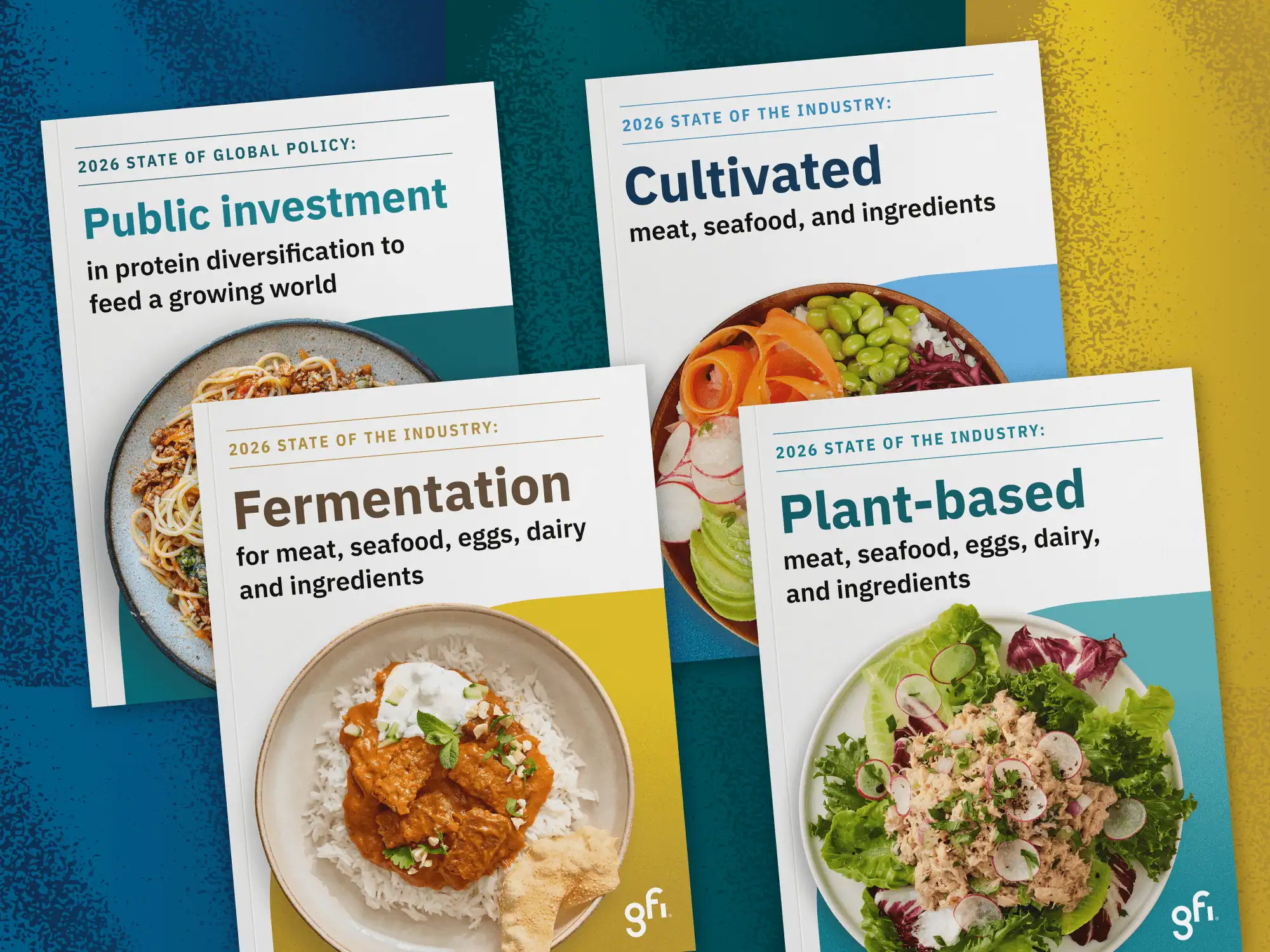
The Good Food Institute (GFI) has published its 2026 State of the Industry report series, providing a comprehensive overview of the plant-based, fermentation-derived, and cultivated meat sectors in 2025. The reports cover commercial activity, investment flows, scientific developments, and regulatory progress across each sector.
While the funding environment tightened across all three categories in 2025, GFI’s analysis points to continued technical and commercial progress, with cost reductions, regulatory milestones, and cross-sector collaboration advancing the field.
Investment down, but fundamentals improving
Private investment declined year-over-year across sectors. Cultivated meat and seafood companies raised $73.9 million in 2025, down from $139 million in 2024, according to GFI’s analysis of Net Zero Insights data. The three largest cultivated meat deals were Aleph Farms’ $29 million raise, Mosa Meat’s $17.6 million round, and BlueNalu’s $11 million in convertible notes and preferred stock financings.
Fermentation-focused companies raised $357 million in 2025, compared to $651 million in 2024. Companies operating primarily in the plant-based ecosystem raised $450 million, up from $309 million in 2024, though GFI notes it was a particularly difficult year for smaller, emerging brands, especially in the United States.
Investors are increasingly focused on unit economics, credible paths to profitability, and demonstrated demand, rather than early-stage potential alone. A handful of high-profile closures and restructurings during the year reinforced this shift in expectations.

Cultivated meat: regulatory traction and a new scale milestone
Seven companies have now received regulatory clearance to sell cultivated meat products globally. As of publication, commercial sales are permitted in Singapore, the United States, and Australia. Food Standards Australia New Zealand finalized a regulatory pathway for cultivated meat in 2025, making it the third jurisdiction to approve a cultivated product, following Singapore and the United States.
On the production side, Australian company Vow reached production at 20,000-liter scale at its Sydney facility, which holds 35,000 liters of total capacity. GFI identifies this as the largest cultivated meat facility currently in operation worldwide. GFI also announced the acquisition of eight bovine cell lines developed by former startup SCiFi Foods, made publicly available through a partnership with Tufts University.
In contrast, the United States scaled back federally funded R&D in 2025, with new federal investment in cultivated meat and enabling technologies declining. China moved in the opposite direction: the state-owned State Development and Investment Corporation committed over CNY 4 billion ($555 million) to advance biomanufacturing infrastructure, with “new proteins” featured prominently in the plan.

Fermentation: scaling progress and a labeling setback
The fermentation sector saw new commercial-scale facilities open in Brazil, Canada, China, Sweden, and the United Kingdom, alongside new product launches across meat, dairy, and ingredients categories. More than 163 specialized companies were active in the space in 2025.
A notable engineering milestone came from Pow.Bio, in collaboration with Bühler, which demonstrated scalable continuous fermentation of high-value dairy proteins at 3,000-liter scale using ATV Technologies. The collaboration achieved a threefold productivity gain and a 50% cost reduction.
South Korea enacted the Food Tech Industry Promotion Act in December 2025, establishing a legal and administrative framework to support innovative food products, including fermentation-enabled categories.
However, EU policymakers agreed in March 2026 to ban the use of the word “meat” and 31 related terms for fermentation-enabled, plant-based, and cultivated products, despite survey data indicating European consumers support the use of these terms for plant-based products.

Plant-based: global sales grow, US headwinds continue
Global retail sales of plant-based meat, seafood, milk, yogurt, ice cream, and cheese reached an estimated $28.9 billion in 2025, a 3% increase from 2024, according to Euromonitor data cited in the report. The plant-based meat and seafood subcategory was estimated at $6.6 billion globally, though performance varied by region, with continued sales declines in the United States offset by growth elsewhere.
Consumer demand for protein-forward products continued to shape innovation. Danone launched Silk Protein, IKEA cafeterias in the United Kingdom added plant-based pork sausages to menus, and McDonald’s India introduced Protein Plus, a plant-based protein slice available as a burger addition.
At least 19 plant-based companies were acquired during the year, as capital consolidates around scalable platforms and established brands. The European Investment Bank provided a €20 million loan to Heura Foods under the EU’s InvestEU program, and MATR Foods completed a €40 million raise with EIB debt and participation from Denmark’s Export and Investment Fund.
Government investment at an inflection point
GFI’s accompanying State of Global Policy report notes that cumulative government investment in alternative proteins has reached at least $2.5 billion globally since 2021, up from approximately $700 million when tracking began. At least 33 countries are now working to advance alternative proteins, compared to 16 at the start of the decade.
However, GFI calculates that current government investment amounts to no more than 10% of the $10.1 billion annual benchmark identified in a Global Innovation Needs Assessment as necessary to fully develop a mature alternative protein sector.
The full suite of 2026 State of the Industry reports is available to download free of charge here