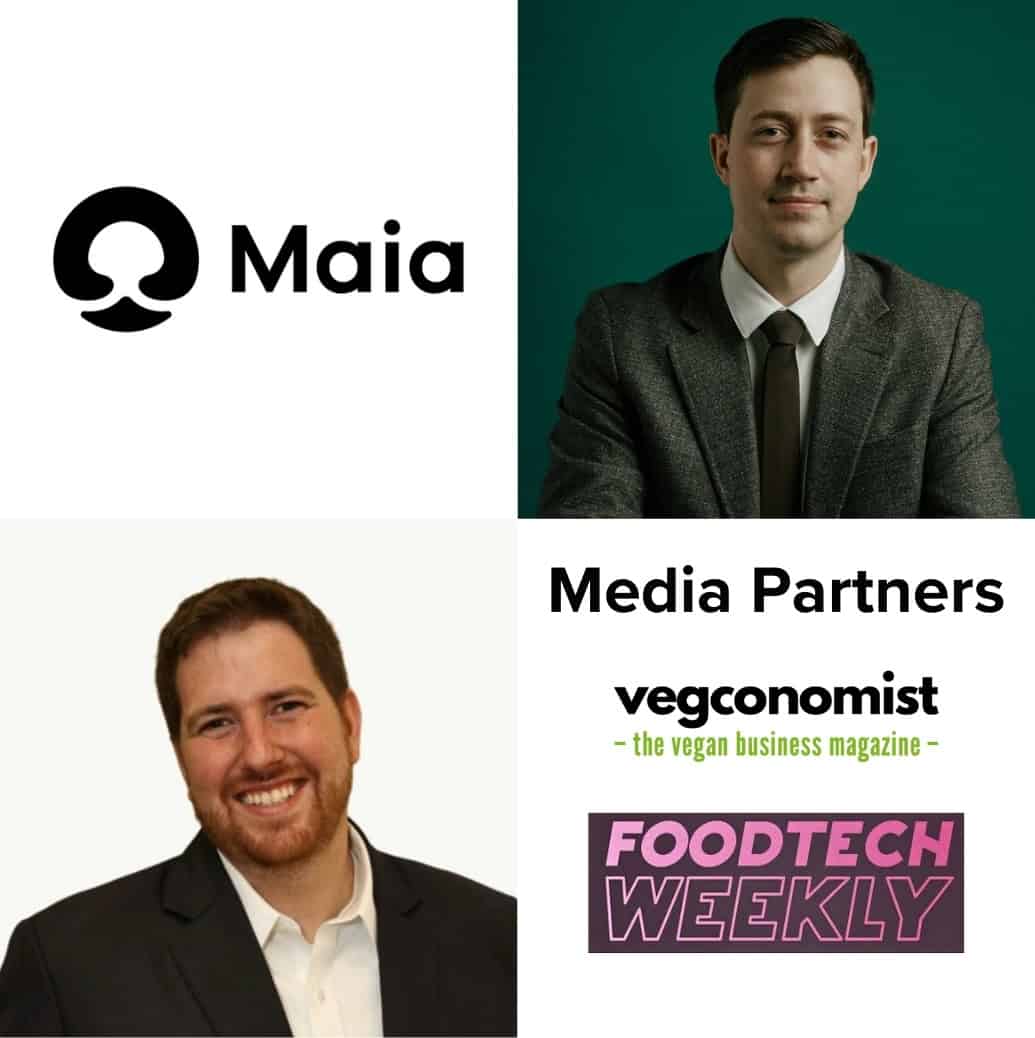
In this podcast series, Alex Shandrovsky interviews investors about benchmarks for funding Alt Proteins in 2025 and uncovers the investment playbooks of successful Climate Tech CEOs and Leading VCs.
Podcast Host Alex Shandrovksy is a strategic advisor to numerous global food tech accelerators and companies, including alternative proteins and cellular agriculture leaders. His focus is on investor relations and post-raise scale for agrifood tech companies. This podcast is syndicated through our media partners, Foodtech Weekly and Vegconomist.
Episode 59: Maia Farms
In this episode, I sit down with Gavin Schneider, CEO and co-founder of Maia Farms, one of the most capital-efficient and rapidly scaling players in the mushroom and mycelium ingredient space. Gavin walks me through how Maia raised $6.5M—not from a planned target list, but from a warm intro by a larger fund that passed on leading and instead connected them to a perfect-fit Vancouver climate investor, leading to one of the fastest close cycles I’ve seen. We get into how Maia built momentum through major Canadian grants, strong customer references, and a data room ready for instant due diligence, and why staying asset-light and profitable matters more than ever in food-tech today. Gavin also shares the real challenge ahead: keeping up with demand as Maia moves from hundreds of tons to thinking in millions of tons of mushroom protein by 2050. This conversation is a masterclass in disciplined scaling, capital strategy, and building a food company that actually feeds people—and I’m excited for you to hear it.
Key Facts Maia Farms:
- Goal: Support food makers with versatile, scalable solutions that outperform soy and mold-based alternatives.
- Recently raised $6.5M with Protein Industries Canada and Greater Vancouver Food Bank (GVFB) as investors.
Alex’s Top Findings:
- Your Lead Investor Might Not Be on Your Original List. Gavin’s lead investor came via a warm intro from a larger fund that ultimately passed on Maia as “too early”—but then made the perfect connection to a local Vancouver climate-focused fund. He underscores the importance of always asking for feedback and referrals when a fund says no, because the best-fit investor may be one degree away, not already on your spreadsheet. ” It was actually an introduction from a larger fund with who we had been engaged and had some discussions. They felt that we were just too early for their stage of investment. So they made an introduction to another group, and things actually happened in quite rapid progression from the time of introduction to closing the deal, and it happened within a matter of weeks. You never know who will get you where you need to go.”
- A Simple, Thoughtful Data Room Beats Fancy Software. For this round, Maia ditched expensive data-room platforms and ran everything through Google Drive, using its newer security features plus a clear structure and “checklist” mindset. Gavin stress-tested the data room with incubator mentors and updated it continuously based on investor objections, treating every “no” as an input to improve the next investor’s experience. “If you’re already paying for [Google], I think that groups that are paying an extra $1,500 for a specialized data room… you’re able to get to the same result and the same level of security today with Google Drive. Follow your standard checklists… and ask yourself as you’re going through it: if I were interrogating this company, what pieces of information would I also like to see here?”
- Valuation, Geography, and Reframing Dilution. Adam says the strongest CEOs today are ruthlessly narrowing scope, cutting burn, and focusing on a small number of milestones that can unlock revenue or strategic partnerships. The “go-big-go-fast” era is dead; survival now requires laser focus. “Valuations for American groups are vastly different from what a Canadian company, an Israeli company, a South Korean company, or a Singapore company will achieve. A lot of people… fear dilution… but it actually means that people believe in your company and your vision and they want to take a risk.”
Link to Apple Podcast here.
Catch the full podcast series here.