Katharina Eist Holland brings a unique combination of commercial strategy, industry expertise, and academic insight to her role at BeneMeat. With a PhD in social science and senior experience across the alternative protein sector, she has helped global companies connect with ethical consumers and successfully bring innovative products to market. Her work is driven by a strong commitment to building a more sustainable food system.
BeneMeat is a biotechnology company focused on enabling the commercialisation of cultivated meat through B2B partnerships. Rather than producing consumer products, the company equips food and pet food manufacturers with the technology, infrastructure, and expertise needed to bring cultivated meat to market — safely, efficiently, and at scale. Based in the Czech Republic, BeneMeat is the first company officially registered to produce cultivated meat for pet food in the EU.
In this interview, Katharina discusses BeneMeat’s strategic entry into the pet food market, the company’s regulatory milestones, and how it is laying the technological foundation for the future of cultivated meat across both pet and human nutrition.
BeneMeat is dedicated to bringing cultivated meat as a next option for people, animals and the planet. Can you share more about the vision driving your mission?
At BeneMeat, our vision is to make cultivated meat a trusted, mainstream protein option for people as well as animals. We don’t see it as a replacement for existing proteins, but as a next option that expands choice and helps address some of the structural challenges of today’s food system.
Our mission is focused on enabling others. We don’t produce consumer products ourselves. Instead, we equip food and pet food manufacturers with the technology, know-how, and infrastructure needed to bring cultivated meat to market. This means developing scalable, efficient, and safe production solutions, from cell lines to bioprocessing, so our partners can focus on creating products people trust and want. By lowering technological and production barriers, we want to support wider adoption of cultivated meat in a way that is economically viable, transparent, and aligned with real-world needs across both human food and pet nutrition. Ultimately, we aim to be a long-term, reliable technology partner.
BeneMeat positions itself as more than just a cultivated meat producer — you’re building the full-scale manufacturing ecosystem. What does this ecosystem include, and why is that end-to-end approach important?
Cultivated meat can only become a true next option if it works at industrial scale, and can be produced economically and reliably. That’s what we want to help our partners accomplish, and that’s what our ecosystem is built to deliver.
It spans the full production chain: robust cell line development, cultivation media optimization to get rid of components such as FBS while driving prices to a market-acceptable level, building safe and sterile production environments, and mastering the transition from lab-scale processes to industrial manufacturing. Each part has to work together, or the whole system fails.
Because cultivated meat is still a young industry, there is little specialized equipment and limited large-scale experience. That’s why our team combines deep expertise across biology, engineering, and manufacturing.
We believe that today, few, if any, have the degree of in-depth understanding of the cultivated meat process that we do.
You chose to enter the market through pet food. What made this the right strategic starting point?
As you know, regulations around cultivated meat are still evolving. Pet food offered a realistic and responsible entry point. The regulatory pathway allowed us to bring cultivated meat to market earlier, while working closely with authorities to build understanding and trust.
In addition, pets are honest customers. Especially cats. They don’t care about cute marketing, and they make their preferences very clear. Starting with pet food allowed us to make cultivated meat tangible, test it in real life, and collect real meaningful feedback on what actually works..
You’re the first company officially registered to produce cultivated meat for pet food in the EU. What did that regulatory process involve, and what does it mean for your future roadmap?
After extensive consultations with the European Food Safety Authority (EFSA) and the European Commission, we applied for, and received, the registration (CZ 802529-01) of our production with the competent authority of the Czech Republic, the Central Institute for Supervising and Testing in Agriculture (ÚKZÚZ) and then listed our cultivated cells in the European Feed Materials Register (ID# 009569) as ‘cultivated cells of mammalian origin.’
More than a regulatory milestone, this creates a foundation of trust, for partners, regulators, and consumers. Thanks to these two key milestones, we can now manufacture and commercially use cultivated meat as an ingredient in pet food across the entire EU market.
Strategically, it’s a starting point rather than an endpoint. We’re already working on additional regions beyond the EU and, in parallel, mapping the more complex regulatory pathways for cultivated meat for human consumption to ensure our technology is ready when the landscape evolves.
Across Europe, studies increasingly show that consumers are open to trying cultivated meat, especially when safety and value are clearly communicated. How does this align with what you observed in your trial?
Yes. It’s great that consumers are beginning to embrace cultivated meat. We saw that openness very clearly in our trial. Whether we were in Vienna or in Amsterdam, we had long lines around our stand, and we’re getting lots of enthusiastic videos from the trial participants.
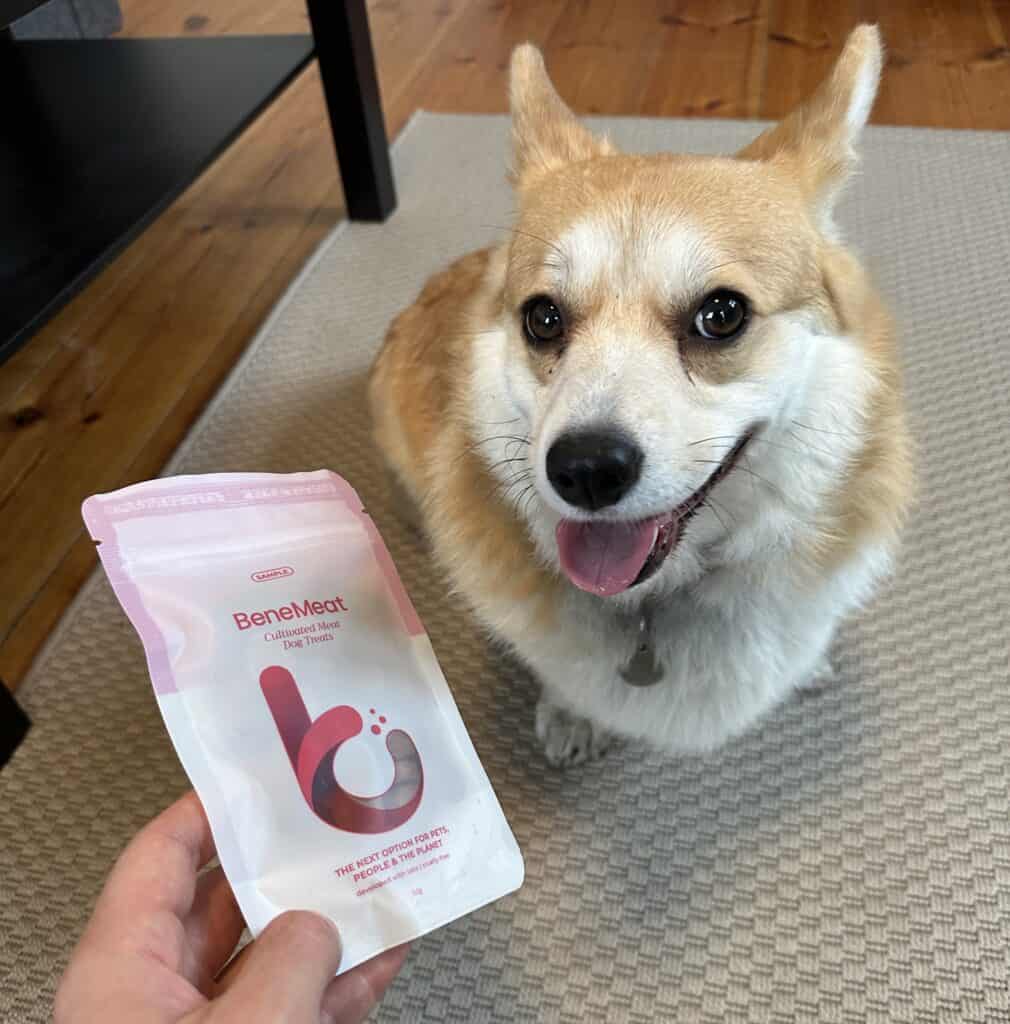
What really matters here is education. After years of hype and missed promises, some skepticism is natural. Cultivated meat is still abstract for many people. When we made it tangible, when people could see it, touch it, and see their dogs enjoy it as much ( some, even better than) their regular treats, acceptance shifted quickly.
Over 96% of participants said they would be comfortable feeding cultivated meat to their dogs, and 85% said they would be willing to do that regularly. That tells us that trust grows when people understand what cultivated meat actually is, and what it isn’t.
Now that the Try & Share Program has concluded, what were the most valuable takeaways?
We only closed signups at the end of December, but we are very pleased with the results so far. One clear takeaway is that a cruelty-free protein option resonates far beyond vegan or vegetarian audiences. Participants were drawn to the idea of feeding their pets a protein that doesn’t require killing other animals.
Another important insight was normalization. Once participants had the product in hand, they evaluated it like any other treat: appearance, size, chewability, and how their pet responded. That’s a good sign. Cultivated meat doesn’t need to be treated as something exotic. Focus on the functional benefits. Consumers already do!.
Did anything in the consumer or pet feedback surprise you (either positively or critically?)
We were positively surprised by the level of enthusiasm and the geographic reach. When we launched, we were hoping for good European coverage – and we got interest from 25 countries! The treats performed well across all key dimensions, with virtually no negative reactions.
That’s exactly what you want to hear. It shows that our product (which included 18% of cultivated meat – a pretty significant chunk, and more than previous product that was tested in the market) performed well and that products with meaningful inclusion levels can work and be attractive to both pets and producers.
What challenges have emerged during the trial — and how are you addressing them?
The challenges were mostly logistical and minor. More valuable was the product feedback: interest in different treat sizes, softer textures, and future options for cats. We’re taking that into account for future product development and next Try & Share waves.
A much bigger, structural challenge continues to be the regulatory environment in Europe. Frameworks differ across countries and continue to evolve, which can create obstacles and even delay launches. For example, we would have liked to include people from Great Britain in the trial, but had to forego that due to evolving regulatory requirements in that country. Similarly, we had a product launch ready in Germany almost a year ago, and due to interpretations of the framework by one of the federal states, had to delay. We’re actively working with authorities and industry partners to help create clearer, more predictable pathways, not just for us, but for everyone in the industry.
What are your next steps toward commercialization?
The Try & Share Program aims to show that cultivated meat is real and can be brought to the market. But our goal is not to become a consumer brand or an end-product manufacturer. We are a biotech company building the technological foundation that allows others to produce cultivated meat at scale, safely and efficiently.
We are now evaluating realistic market pricing and acceptable margins. We’re already in active discussions with several partners interested in launching products based on our technology. While we support recipe development and tech integration, the final products will be brought to market by our partners. Our role is to make cultivated meat a reliable, scalable option they can trust.
What’s next for BeneMeat in 2026 and beyond?
We are preparing the next wave of our Try & Share Program to continue making cultivated meat tangible for consumers.We continue optimizing our technology to further drive cost efficiency and affordability. We continue working with the regulatory authorities across the globe to open the markets for cultivated meat at scale.
Last, but definitely not least, we are starting to look at human food prototyping and product development.