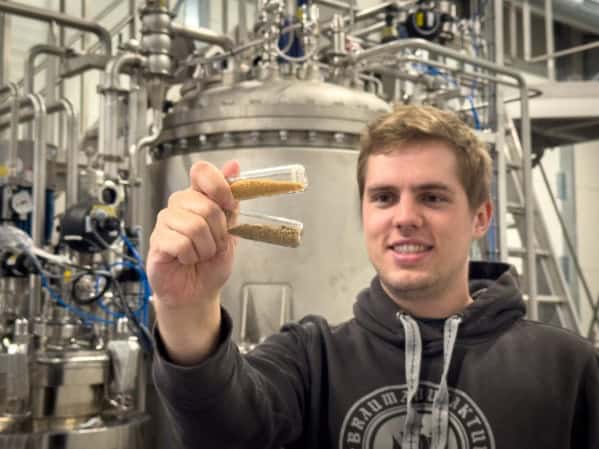
EAT BEER, a biotechnology company specializing in the transformation of side streams from the brewing and food industries into fungal protein raw materials for the food industry through fermentation, has entered the pilot phase of its production. The sister company of Störtebeker Braumanufaktur is a spin-off from the research project MaltFungiProtein, which is funded by the German federal government, and specializes in the fermentation of brewery by-products using fungi. Since the completion of the research project in autumn 2025, its pilot plant EAT BEER has been used for its own series of experiments. Dr Mark Schneeberger, CTO of EAT BEER: “We are currently using the technical centre to optimise the fermentation process and the end product, a protein-rich oyster mushroom mycelium. At the same time, the data obtained is helping us to further develop our AI, which, together with the fermentation plant, will be at the heart of our platform in the future.”
EAT BEER is working on a modular industry solution that will enable breweries to produce proteins for the food industry from spent grain using the dark factory principle, i.e. without additional labour and in a straightforward manner at their own premises.
Usable fungal protein from the pilot fermenter
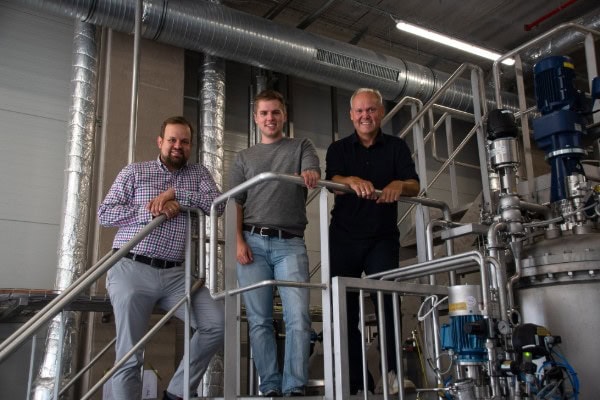
The pilot plant, featuring a 500-liter fermenter developed in collaboration with Northern German plant manufacturer TAB, forms the basis for the food technology processes. In addition, the young company, led by managing directors Malte Nordmann and Jens Reineke along with CTO Dr. Mark Schneeberger, is working on the logistical and digital foundations for the integrated system. “What we are doing here is pure innovation; there are no off-the-shelf solutions,” says Dr. Mark Schneeberger. He adds: “We had to explore every single step in the process ourselves, from the correct processing of the spent grain to the storage of the protein.” Now, regardless of the type of grain—wheat, rye, or barley—the process consistently yields highly usable mycelium mass. “The goal for 2026 is to standardize the procedures under various conditions and thus gradually prepare for market readiness,” says Mark Schneeberger.
Continuous pilot operations and scalable platform solutions for 2026
The pilot plant will therefore continue to run in permanent operation throughout 2026. On one hand, Störtebeker, EAT BEER, and partners from the food processing industry use the mycelium for culinary trials in food production, such as the development of meat alternatives. On the other hand, the company continuously generates valid data while recording all possible occurrences during daily production.
Malte Nordmann explains: “Our goal is to enable other breweries to implement the fermentation process at their own locations. Since every brewery works with different raw materials, recipes, and procedures, our system must be flexibly applicable to a wide variety of frameworks. Therefore, all deviations from the standard process that we record today are valuable pieces of information for the future.” In the long term, EAT BEER aims to implement a scalable platform solution at brewery sites that uses AI software to autonomously and individually manage the entire fermentation and manufacturing process.
Personnel expansion and the path to EU novel food approval
In 2026, EAT BEER also plans to grow its workforce, partly to create capacity for structural projects. For instance, the issue of EU approval is becoming increasingly urgent: the proteins produced by EAT BEER fall into the “Novel Food” category and must be authorized by the EFSA (European Food Safety Authority).
Dr. Mark Schneeberger explains: “We cannot actively accelerate the approval process, but we can support the EFSA’s work with verifiable data and insights, as well as through real-world laboratories. At the same time, we will use this period to conduct educational outreach regarding our oyster mushroom protein with potential partners, customers, and end consumers to promote consumer acceptance. In doing so, we aim to pave the way for the industry to produce proteins from brewers’ spent grain.”