Researchers at the Hebrew University of Jerusalem have developed a cellulose-based scaffold that reduces the quantity of growth factors needed to produce cultivated meat tissue by up to tenfold, according to a study published in Current Research in Food Science.
Growth factors, the proteins that direct stem cells to proliferate and differentiate into muscle tissue, account for more than 95% of media costs in cultivated meat production and remain one of the primary obstacles to price competitiveness with conventional meat.
The team, led by Dr. Sharon Schlesinger, found that binding growth factors directly to a food-safe cellulose scaffold, rather than dissolving them in liquid growth medium, delivered comparable results while using a fraction of the proteins.
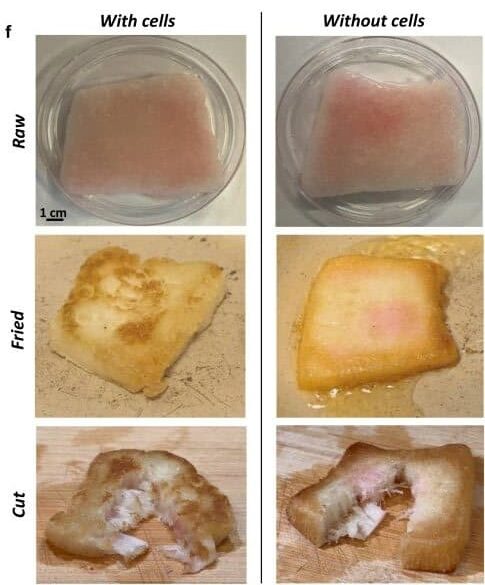
The scaffold is made from plant-derived cellulose processed into a porous, channelled structure designed to mimic the natural architecture of muscle tissue. Stem cells seeded onto it grew in organized, parallel arrangements, and over several weeks differentiated into both muscle and fat tissue. Mechanical testing showed the resulting constructs approached the stiffness and texture of conventional sirloin, and when pan-fried, the material browned and held its shape.
“We made another step to eventually obtain a cut that will look like a steak, feel like a steak, taste like a steak, and contain exactly the same components found in a steak,” Schlesinger told The Press Service of Israel. “We did it in a form that will imitate the real thing as closely as possible, without the need to raise, feed, water and deal with all the environmental consequences of livestock farming, and also without slaughtering the animal.”
Still early stage
The researchers acknowledge the work remains proof of concept. Fetal bovine serum was present in all experiments, some differentiation components are not food-safe, and the cellulose nanocrystals central to the scaffold’s structure are not yet FDA- or EFSA-approved for food use, though an FDA application is in progress.
Schlesinger continued, “Cultivated meat is a field that will make this possible. There are many plant-based substitutes in supermarkets. This field is much more complicated, but it holds great promise. It will be exactly like the real thing. Investment is needed for that to happen, and it may take years.”
The study was funded in part by the Good Food Institute and the Israeli Innovation Authority.