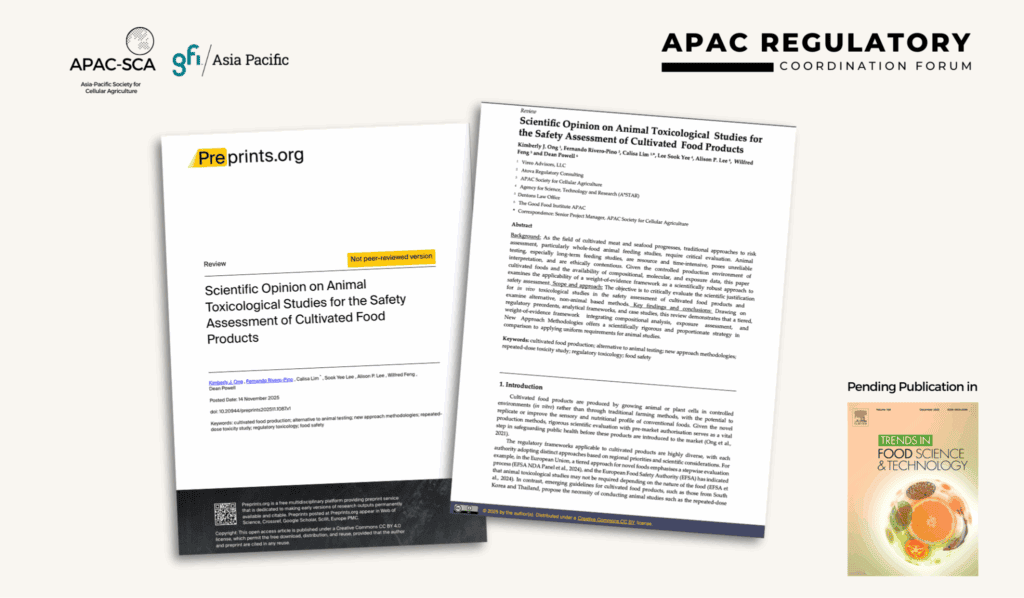
The APAC Regulatory Coordination Forum has published a review paper evaluating whether whole-food animal toxicological studies are appropriate for testing the safety of cultivated foods and food ingredients.
Scientists have reportedly raised concerns about the reliability, cost, time-intensiveness, and ethics surrounding long-term, whole-food animal feeding studies. Alternative, non-animal-based testing methods are claimed to provide more relevant, specific, timely, and humane solutions for safety evaluation.
The review paper brings together insights from cultivated food companies, industry associations, think tanks, governmental agencies, and regulators across ten APAC jurisdictions. It also discusses a case study involving a 90-day oral toxicity study, which experts claim provided limited added value for whole cultivated food products.
“This commentary highlights a growing consensus that traditional whole-food animal studies are often ill-suited for cultivated foods, and that modern evidence-based approaches offer a more meaningful path forward,” said Dr. Kimberly J. Ong, Ph.D, a toxicologist at Vireo Advisors. “My hope is that this paper helps align industry and regulators around rigorous, science-driven frameworks that maintain high safety standards without relying on unnecessary animal testing.”
“Toxicological studies are not always required”
The review paper has been submitted to the journal Trends in Food Science & Technology, and open access has been provided by the Good Food Institute APAC. The pre-print paper is currently undergoing peer review.
Regulatory bodies are increasingly adopting the “three Rs” (replace, reduce, and refine) as principles for food safety assessments. The new paper could reportedly serve as a key scientific reference document, enabling regulators to construct review frameworks that reflect modern scientific best practices.
The news comes a year after the APAC Regulatory Coordination Forum released two white papers addressing essential safety and regulatory concerns to support the commercialization of cultivated meat.
“As with any other (novel) food, toxicological studies are not always required to assess safety,” said Dr. Fernando Rivero-Pino, Ph.D, regulatory scientist and toxicologist at Atova Regulatory Consulting. “In the case of cultivated foods, traditional animal studies may not be the most appropriate way to address potential concerns. Instead, a weight-of-evidence approach that relies on process understanding, analytical data, and new approach methodologies can provide a more relevant and reliable basis for safety evaluation. I hope this commentary helps move the discussion about how to properly assess the safety of these products.”